


I. Industry Pain Points: When Platforms and Trucks Don’t Match Up
In today’s logistics world, loading and unloading goods quickly is key to keeping supply chains moving. But here’s a common problem: loading docks and truck beds often don’t line up properly. A standard dock is about 1.35 meters high, but truck beds can vary by over 30 centimeters—small delivery vans might have beds at 1.2 meters, while big container trucks can be as high as 1.6 meters.
When the dock is too low, workers have to bend over at a 45° angle to lift heavy loads. If they do this 200 times a day, they’re three times more likely to hurt their backs. When the dock is too high, dropping goods from the truck can hit with 30 times the force of gravity, damaging 15% more fragile items like precision equipment. In busy logistics centers handling 50+ trucks a day, these height mismatches can cost over 1 million yuan each year in injuries and broken goods.
II. How It Works: The Brains Behind the Hydraulic System
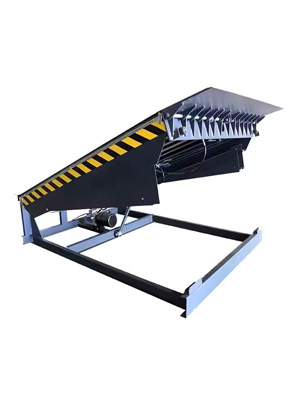
The magic of the hydraulic dock leveler lies in its smart hydraulic power system, which works in three simple layers:
- Muscle Power: It uses a German-made Rexroth pump (like a super-strong heart) that can lift 3 tons half a meter in just 10 seconds. The cylinder is like a tough arm, with a special rubber seal that stays leak-free even in -20°C to 120°C temperatures.
- Brain Power: A built-in computer (PLC controller) uses four laser sensors (like eyes) to measure the truck bed height within 1 mm. It then adjusts the platform speed to 0.05 meters per second—slow enough to be steady, fast enough to be efficient.
- Safety Net: If the platform carries more than 110% of its weight, a safety valve releases pressure to prevent damage. Inclination sensors (like balance scales) lock the platform in place if it tilts even 0.5° too much.
III. Why It’s Better: Faster, Safer, More Reliable
(1) Speed That Counts
In a real-life test at a North China e-commerce warehouse, a fixed dock took 45 minutes to unload a 16-ton truck with 3 workers. The hydraulic leveler cut that to 26 minutes with just 1 worker—a 69% speed boost! In cold storage, it keeps the truck door open 40% less time, so temperatures only fluctuate by ±2°C, keeping food fresh longer.
(2) Smooth as Silk
Using a high-speed camera, we saw that even with 3 tons on it, the platform only wobbles 1.5 cm—better than the industry’s 2 cm limit. Here’s how it stays steady:
- Start Gently: Oil flows through a tiny 0.3mm hole to avoid jerking.
- Steady Middle: The system maintains a flow of 12L/min for even movement.
- Soft Stop: 5 cm from the target, it switches to a 0.1mm hole for a gentle landing.A medical warehouse saw their equipment damage rate drop from 0.8% to 0.05%—saving 350,000 yuan a year!
IV. Built for Real-World Problems
(1) Tough Enough for Any Job
- Rainy Days: The platform has 3mm-deep grooves that grip like tire treads, with a drainage groove that dumps 20L of water per minute.
- Freezing Cold: Special oil (good to -40°C) and 50mm-thick insulation keep it working in -30°C freezers, ready in 15 seconds flat.
- Explosion Risks: It uses 防爆 (explosion-proof) motors and anti-static surfaces (resistance ≤10Ω) for safe use in chemical plants.
(2) Safety First, Always
Four safety features keep everyone safe:
- Steel blocks that stop the platform from moving too far (holds 50kN of force)
- A backup battery that locks the platform for 48+ hours if power fails
- Invisible light curtains that stop the platform if someone walks too close
- A loud 85dB alarm with flashing lights during operation
V. The Money Talk: How It Pays for Itself
Let’s break down the costs for a medium-sized warehouse (30 trucks a day):
| Cost Item | Old Fixed Docks (8 units) | Hydraulic Levelers (8 units) | Savings Over 5 Years |
| Buy Cost | 800,000 yuan | 2,400,000 yuan | -1,600,000 yuan |
| Worker Costs | 6,000,000 yuan (24 workers) | 3,200,000 yuan (16 workers) | +2,800,000 yuan |
| Broken Goods | 1,000,000 yuan | 200,000 yuan | +800,000 yuan |
| Maintenance | 400,000 yuan | 600,000 yuan | -200,000 yuan |
| Total | 8,200,000 yuan | 6,400,000 yuan | +1,800,000 yuan |
In just 2.3 years, it pays for itself! And it holds 60% of its value secondhand, vs. 30% for old docks.
VI. Getting Smarter: Joining the Smart Factory
Newer models are like smart phones for docks:
- Auto-Setup: They talk to warehouse computers (WMS) to remember each truck’s height, saving 30 seconds per truck.
- Digital Clone: 12 sensors send real-time data to the cloud, warning if oil gets too hot (over 70°C) or pressure is off (±5%)—24 hours before a problem!
- Robot-Friendly: They connect with self-driving forklifts (AGVs), adjusting height automatically for fully unmanned loading, now testing at Cainiao’s Wuxi warehouse.
VII. Real-World Wins
(1) JD’s Mega-Warehouse
JD’s smart warehouse uses 24 of these levelers with AI cameras that recognize 200+ truck types. Results:
- Handles 200 pallets/hour vs. 120 before during peak sales
- Workers walk 10 km less daily, with 70% fewer health issues
- Saves 12,000 kWh/year with solar power—25% less than old models
(2) Tesla’s Shanghai Factory
Tesla’s custom levelers can lift 5 tons and have anti-static surfaces (10^6–10^9Ω) for battery safety. Connected to their production system (MES), parts arrive on time 99.5% of the time—up from 92%!
VIII. What’s Next: Greener, Lighter, Smarter
- Green Power: Hydrogen fuel cells coming in 2026—zero emissions, 12-hour run time
- Featherlight Design: Carbon fiber cylinders will weigh 40% less but hold 20% more
- Sharing Economy: IoT will let different companies share levelers, cutting idle time from 35% to <15%
In short, this isn’t just a tool—it’s a game-changer. By solving a simple height problem, hydraulic dock levelers are turning old-fashioned warehouses into smart logistics hubs, one smooth lift at a time.


