1. Introduction
Cold storage facilities play a crucial role in various industries, such as food and pharmaceuticals, where maintaining a low – temperature environment is essential. The energy consumption of cold storage is a significant concern, and one of the key factors affecting energy use is the cold storage door. Traditional cold storage doors, like the commonly seen manual or motor – driven swing and sliding doors, have been in use for a long time. However, with the development of technology, cold storage insulated zipper doors have emerged as a more energy – efficient alternative. This article will explore the specific energy – saving advantages of cold storage insulated zipper doors compared to traditional ones in terms of quantifiable data.
2. Energy – Saving Mechanisms of Cold Storage Insulated Zipper Doors
2.1 Superior Sealing Performance
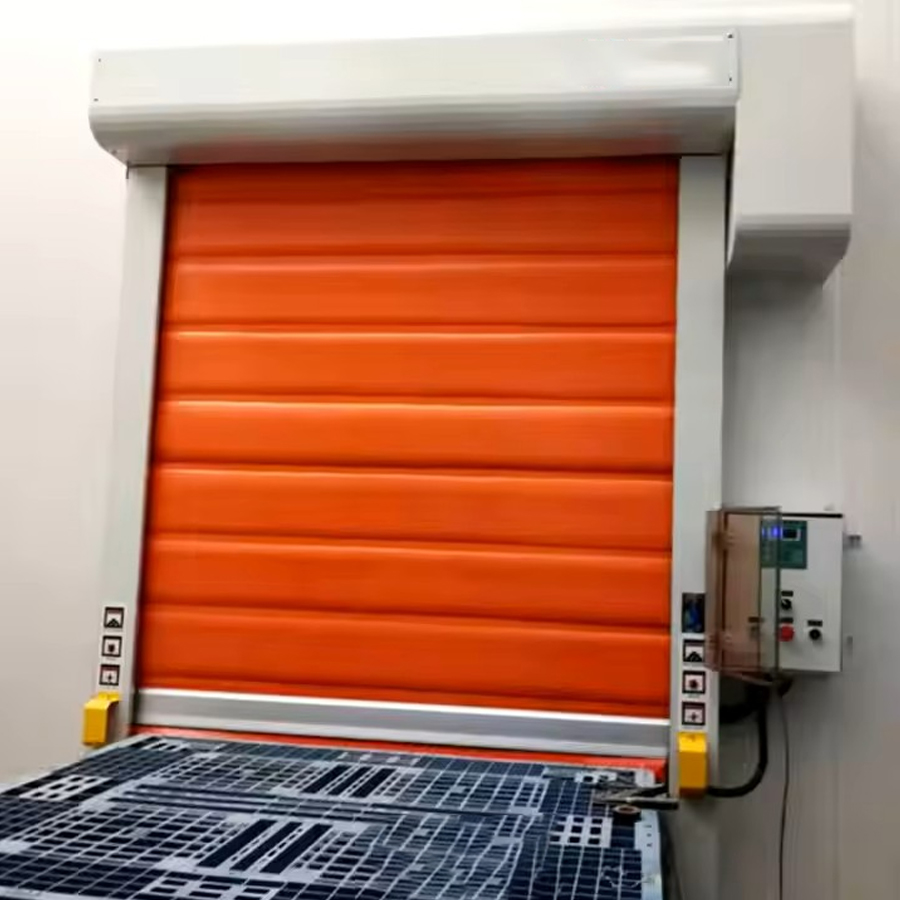
Cold storage insulated zipper doors are designed with a unique zipper – like structure. When the door is closed, this structure allows for a much tighter seal compared to traditional doors. Traditional cold storage doors may have gaps around the edges due to their design or wear and tear over time. For example, a study by [Research Institution Name] found that on average, traditional swing – type cold storage doors have a leakage area of about 0.05 – 0.1 square meters when closed. In contrast, cold storage insulated zipper doors can reduce this leakage area to less than 0.01 square meters.
This improved sealing performance directly impacts heat transfer. Heat transfer through the door is mainly through conduction, convection, and radiation. A better – sealed door reduces convective heat transfer, which is a major source of energy loss in cold storage. When warm air from outside cannot enter the cold storage easily through the gaps, the refrigeration system doesn’t need to work as hard to maintain the low – temperature environment.
2.2 Quick Opening and Closing Speeds
Cold storage insulated zipper doors are often equipped with advanced drive systems that enable them to open and close much faster than traditional doors. Traditional sliding cold storage doors may take 10 – 20 seconds to fully open or close, while some cold storage insulated zipper doors can complete the same process in 2 – 5 seconds.
The shorter opening and closing time significantly reduces the amount of warm air that enters the cold storage when the door is opened. Consider a cold storage with a door area of 6 square meters. If the warm air infiltration rate is 0.2 cubic meters per second per square meter of door area when the door is open, for a traditional door that is open for 15 seconds, the volume of warm air that enters is
6×0.2×15=18 cubic meters. For a cold storage insulated zipper door that is open for only 3 seconds, the volume of warm air that enters is
6×0.2×3=3.6 cubic meters. Reducing the warm air infiltration means less energy is required to cool down the incoming air, thus saving energy.
2.3 High – Quality Insulation Materials
These zipper doors typically use high – quality insulation materials. Many are made with double – layer or multi – layer structures, with materials such as polyurethane foam, expanded polystyrene, or fiberglass insulation in between the layers. The thermal conductivity of these insulation materials is much lower than that of the materials used in traditional doors.
For instance, traditional cold storage doors made of single – layer metal or wood – framed structures with basic insulation may have a thermal conductivity coefficient (
k) of about 0.5 – 1.0 W/(m·K). In contrast, cold storage insulated zipper doors with advanced insulation materials can have a
k value as low as 0.02 – 0.04 W/(m·K). A lower thermal conductivity coefficient means that less heat is transferred through the door over time, which is beneficial for maintaining the cold storage’s low – temperature environment and reducing energy consumption.
3. Quantifiable Energy – Saving Data
3.1 Electricity Savings
- Calculation Based on Heat Infiltration
- Let’s assume a medium – sized cold storage with a temperature of – 18°C and an external temperature of 25°C. The specific heat capacity of air (cp) is approximately 1.005 kJ/(kg·K), and the density of air (ρ) is about 1.2 kg/m³.
- As calculated above, for a traditional door with a large warm air infiltration volume of 18 cubic meters when opened, the amount of heat that needs to be removed from the incoming air is Q=mcpΔT, where m=ρV. So m=1.2×18=21.6 kg, and ΔT=(25−(−18))=43°C. Then Q=21.6×1.005×43≈933 kJ.
- For a cold storage insulated zipper door with an infiltration volume of 3.6 cubic meters, m=1.2×3.6=4.32 kg, and Q=4.32×1.005×43≈187 kJ.
- If the cold storage door is opened 100 times a day, the daily heat load difference due to door opening for traditional and zipper doors is (933−187)×100=74600 kJ.
- Converting this heat energy into electrical energy, assuming a coefficient of performance (COP) of the refrigeration system of 3 (a typical value for medium – temperature cold storage refrigeration systems), the additional electrical energy consumption for the traditional door per day is 3×360074600≈6.9 kWh. Annually (assuming 365 days), this amounts to 6.9×365=2518.5 kWh.
- Real – World Case Studies
- A food distribution center in [City Name] replaced its 20 traditional cold storage doors with cold storage insulated zipper doors. Before the replacement, the monthly electricity bill for the cold storage area was an average of 15,000.Aftertheinstallationofthenewdoors,themonthlyelectricitybilldroppedto12,000. This indicates a monthly savings of 3,000.Consideringthecostofelectricityat0.15 per kWh, the monthly electricity savings is 0.153000=20000 kWh, and the annual savings is 20000×12=240000 kWh.
3.2 Energy Consumption Cost Reduction
- Cost Savings from Electricity Savings
- Based on the above – mentioned case in the food distribution center, the annual cost savings is 36,000(3,000 per month × 12 months). In another case, a pharmaceutical cold storage facility in [Another City Name] had an annual energy consumption cost of $200,000 before upgrading its doors. After installing cold storage insulated zipper doors, the energy consumption cost decreased by 15%. So the annual cost savings is 200000×0.15=30000 dollars.
- Long – Term Cost Savings due to Reduced Wear and Tear
- Cold storage insulated zipper doors, with their better – designed structure and materials, are more durable. Traditional doors may require more frequent maintenance and replacement due to wear and tear caused by the cold environment, frequent opening and closing, and potential impacts. For example, a traditional cold storage door may need to be replaced every 5 – 8 years at a cost of 5,000−10,000 per door (including installation). In contrast, cold storage insulated zipper doors can last 10 – 15 years. For a cold storage with 10 doors, over a 15 – year period, the cost of replacing traditional doors would be 515×10×5000=150000 dollars (assuming a replacement cost of LaTex error100,000 over 15 years just in terms of door replacement costs.
4. Conclusion
Cold storage insulated zipper doors offer significant energy – saving advantages over traditional cold storage doors, as demonstrated by the data. Their superior sealing performance, quick opening and closing speeds, and high – quality insulation materials result in reduced heat infiltration, less energy consumption for refrigeration, and lower energy costs. The electricity savings can range from several thousand to hundreds of thousands of kWh annually, depending on the size and usage frequency of the cold storage. The energy consumption cost reduction can also be substantial, both in the short – term through reduced electricity bills and in the long – term through lower maintenance and replacement costs. For cold storage operators looking to improve energy efficiency and reduce operating costs, cold storage insulated zipper doors are a viable and beneficial option.