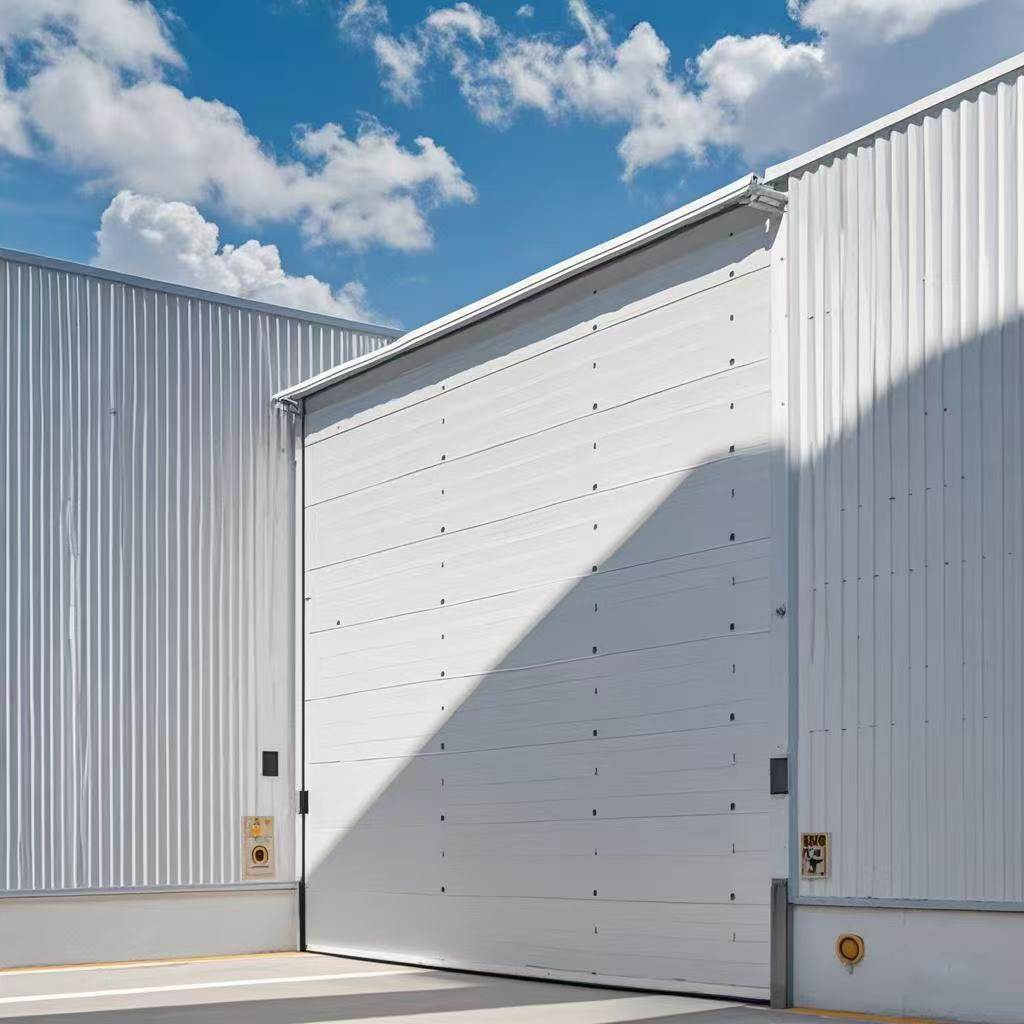
Industrial vertical lift doors, with their characteristics of high efficiency, safety, energy efficiency, and high space utilization, are widely suitable for various scenarios with high requirements for traffic efficiency, environmental control, and building space. Below are their main application scenarios and adaptation features
Large equipment access channels: Such as mechanical processing workshops and heavy equipment assembly workshops. The vertical lifting of the door does not occupy ground space, facilitating the transportation and installation of large machine tools and production line equipment.
Warehousing and logistics entrances/exits: Warehouses require frequent access by forklifts, trucks, and other transportation tools. The fast-opening vertical lift door reduces cargo loading/unloading waiting time while isolating the warehouse area from the external environment (e.g., dust, insects).
High-space factories: In factories with high ceilings (e.g., steel-structured plants), vertical lift doors make full use of upper space, avoiding the ground space occupation of traditional swing doors or rolling shutters.
Adaptation Advantages
Wind-resistant design: Meets the needs of strong wind conditions in industrial environments (e.g., coastal factories), with some models capable of resisting instantaneous wind forces of level 10.
Thermal insulation and energy efficiency: For workshops involving constant temperature processes (e.g., precision machining, food cold storage), the door panel’s polyurethane thermal insulation layer reduces energy consumption.
2. Logistics Centers and Warehousing Facilities
Core Scenarios
High-speed sorting area entrances/exits: Logistics centers require rapid cargo flow. The high-frequency opening/closing of vertical lift doors (some models support hundreds of openings/closing per day) and automatic sensing functions (e.g., radar, geomagnetic rings) improve sorting efficiency.
Cold storage and cold-chain warehouses: The high airtightness and thermal insulation of the door panels prevent cold air loss, reduce cold storage energy consumption, and the anti-condensation design avoids condensate water affecting cargo storage.
Cross-regional isolation channels: Used to separate different temperature zones (e.g., cold storage and normal temperature areas) or clean and non-clean areas, maintaining environmental stability in each zone.
Adaptation Advantages
Safety protection: Equipped with infrared sensors or safety airbags to prevent forklifts from colliding with the door or injuring operators.
Multi-door 联动 control (multi-door linkage control): Can be integrated with WMS (Warehouse Management System) to achieve synchronous opening/closing of multiple doors or automatic control according to logistics routes.
3. Garages and Parking Lots (Including Special Vehicles)
Core Scenarios
Large garage entrances/exits: Such as bus depots and truck parking lots. Vertical lift doors can accommodate the passage of ultra-high and ultra-wide vehicles (e.g., double-decker buses, container trucks) without occupying parking area space.
Special vehicle maintenance workshops: Rapid access for special vehicles like fire trucks and engineering rescue vehicles requires fast door opening speed (some models 可达 0.25m/s, can reach 0.25m/s) and support for one-click opening via emergency buttons.
Underground garage entrances/exits: In space-constrained underground scenarios, vertical lift doors avoid the top space occupation of traditional rolling shutters while reducing vehicle entry/exit noise.
Adaptation Advantages
Low-noise operation: Galvanized pulleys and rubber wheel designs reduce friction noise, suitable for garages near urban centers or residential areas.
Impact resistance: The high-strength door panels can withstand minor collisions (e.g., vehicle scratches), reducing maintenance costs.
4. Commercial and Public Facilities
Core Scenarios
Large supermarket warehouse entrances: The docking channel between supermarket back warehouses and logistics distribution vehicles, which needs to balance cargo access efficiency and indoor temperature control (e.g., fresh produce storage areas).
Airport cargo areas and aircraft hangars: Oversized vertical lift doors (up to tens of meters in height and width) for aircraft maintenance hangars, meeting aircraft access needs while having special properties like explosion resistance and wind pressure resistance.
Public transportation hubs (e.g., metro vehicle depots): Entrances/exits of metro train maintenance depots, where door bodies can be linked with track signaling systems to ensure traffic safety.
Adaptation Advantages
Customizable dimensions: Can be custom-built for non-standard architectural openings, adapting to unconventional heights or widths (e.g., curved or irregular openings).
Intelligent integration: Supports linkage with security systems (e.g., access control, video surveillance) to enhance public area safety.