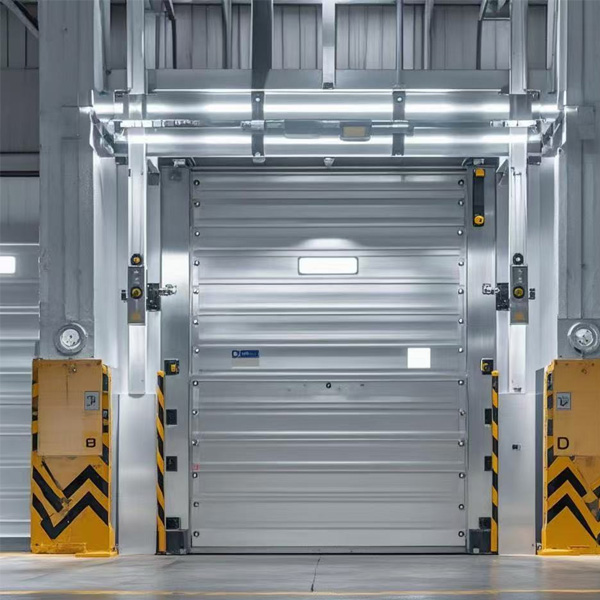
Industrial sectional overhead doors play a vital role in safeguarding the premises and personnel within industrial facilities. To ensure safe operation, various safety protection measures are incorporated into their design.
One of the essential safety features is the anti-fall device. This mechanism is designed to prevent the door from suddenly dropping in case of a malfunction or component failure. It typically consists of a braking system or a mechanical catch that engages when an abnormal descent is detected. The reliability of anti-fall devices is of utmost importance. High-quality anti-fall devices are engineered to withstand significant forces and have redundant safety mechanisms. They are regularly tested during the manufacturing process and should also be inspected and maintained periodically. However, if not properly installed or maintained, their effectiveness can be compromised. For example, if the sensors associated with the anti-fall device are misaligned or damaged, it may not activate in a timely manner.
Another crucial safety measure is the infrared sensor anti-pinch function. Infrared sensors are installed along the sides and bottom of the door. These sensors emit an infrared beam, and when an object interrupts the beam during the door’s closing process, the door immediately stops and reverses its direction. The reliability of this function depends on several factors. The sensitivity of the infrared sensors must be properly calibrated. If the sensitivity is set too low, it may fail to detect small objects or body parts, increasing the risk of pinching. Additionally, environmental factors such as dust, dirt, and extreme temperatures can affect the performance of the infrared sensors. Regular cleaning and calibration of the sensors are necessary to maintain their reliability.
Some industrial sectional overhead doors also feature safety edges. These are soft rubber or plastic strips installed along the edges of the door panels. When the door makes contact with an object, the pressure on the safety edge triggers a sensor that stops and reverses the door. The durability and sensitivity of the safety edges are key to their reliability. Over time, the safety edges may wear out or become damaged, reducing their ability to detect impacts accurately.
In conclusion, the safety protection measures of industrial sectional overhead doors, including anti-fall devices, infrared sensor anti-pinch functions, and safety edges, are crucial for preventing accidents. However, their reliability is contingent on proper installation, regular maintenance, and calibration. Facility managers and operators must ensure that these safety features are in optimal working condition to protect the safety of personnel and property.